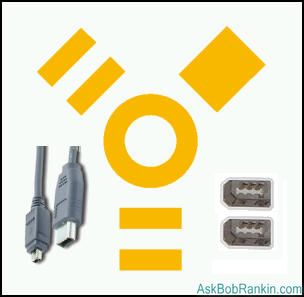
Firewire, also known as IEEE 1394 and i.Link, is a high speed serial bus developed by Texas Instruments and Apple computers in the mid 1990s. Firewire is compatible with more than 63 electronic and digital devices, which makes it a great choice for many people. Technically speaking, Firewire is a PC serial bus interface standard that offers isochronous data services and high-speed communications between digital devices. Basically, Firewire facilitates faster data transfer rates and usability across multiple devices.
Firewire is similar to Universal Serial Bus (USB), but it has a higher data transfer capacity - up to 800 Mbps, compared to the USB's 480 Mbps. This makes it ideal for peripherals that require high-speed data transfer, such as digital camcorders, DVD players and digital audio equipment.
Features of firewire
FireWire can connect up to 63 devices together, and allows peer-to-peer connectivity (i.e., between a camera and printer). It also uses isochronous real time data services which allows for real-time data transfer between a peripheral (i.e., a camcorder) and a host computer or device, with guaranteed bandwidth and no error correction.
This allows users to edit and create custom video projects with fast hard drives, a digital camcorder and a computer. Given the right software, a computer can download material from the camera automatically and with perfect digital clarity. Since the content is digital from start to finish, there is no loss of quality as you work on successive generations using the same material.
(From a different website)The need for FireWire and other next generation networks like it is being driven by a rapidly growing need for mass information transfer be it for the desktop computer in the office or, for the manufacturing process on the shop floor. Typical local area networks can not provide cost effective connections nor do they easily support guaranteed bandwidth for real time applications. Additionally, parallel high speed communications methods such as SCSI are not suited to long distances. These benefits of FireWire combined with the hot plugging" capability makes it a very attractive connection method. "Hot plugging" allows a user to connect or disconnect devices without first turning off the power to the system. Systems running FireWire will automatically recognize and re-configure when a device is connected or disconnected.
One of the interesting features of FireWire is its capability to support both asynchronous and isochronous data transfers. Asynchronous mode is supported in the sense that the data to be sent is grouped and sent as a packet at irregular intervals as determined by the arbitration scheme. Isochronous mode on the other hand issues packets at a pre-determined rate. This is especially important for time-critical multimedia data where the predetermined rate can eliminate the need for costly buffering. Isochronous format is viewed as important for support of real time critical applications where video and audio must operate on the same bus and in some applications it's being investigated as a potential candidate for interfacing controls to digital servo drives.(ends)
Working of firemire
When you turn on a computer, it automatically queries all peripherals attached to it, and assigns each one an address in a process called enumeration. FireWire makes use of 64-bit fixed addressing, based on the IEEE 1212 standard. Each packet of information sent by a peripheral over FireWire has three parts:
A 10-bit bus ID, to determine which FireWire bus generated the data,
A 6-bit physical ID to identify the device which sent the data, and
A 48-bit storage area is there capable of addressing 256 terabytes of information for each node.
The bus and physical ID comprise the 16-bit node ID, which allows for 64,000 nodes on a system. Data can be sent through up to 16 hops (device to device). Hops take place when a series of devices are connected.
For example, a camcorder is connected to an external hard drive attached to Computer A. The latter is then linked to Computer B, which is in turn coupled to Computer C. All devices can then access and
make use of the camcorder; Computer C, however, requires four hops to access the camera. If all of the devices in this setup are equipped with FireWire 800, the camcorder can be up to 400 meters from Computer C (given 100 meters of cable between each device).
FireWire devices can be powered or un-powered; two power conductors built into the cable can supply power (8 to 30 volts, 1.5 amps maximum) from the computer to an un-powered device. Two twisted pair sets carry the data in a FireWire 400 cable using a 6-pin configuration. Some smaller FireWire-enabled devices use 4-pin connectors to save space, omitting the two pins used to supply power.
The "firewire" standard was developed through the IEEE (Institute of Electrical and Electronics Engineers)Standards Program and is known as IEEE 1394.
ReplyDeleteThere are currently other standards projects in developmen in this technica space. You can learn more at: http://grouper.ieee.org/groups/1394/3/index.html#RELATED