JAINISM INTRODUCTION


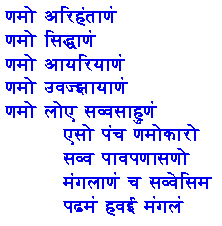
"Namo ariha.ntaaNaM
Namo siddhaaNaM
Namo aayariyaaNaM
Namo uvajjhaayaaNaM
Namo loe savvasaahuNaM
ma.ngalaaNaM cha savvesim
paDhamaM hava{ii} ma.ngalaM"

eso pa.ncha Namokaaro
savva paavapaNaasaNo

MEANING OF NAVKAR MANTRA
I bow to the Arahants, the perfected human beings, Godmen.
I bow to the Siddhas, liberated bodiless souls, God.
I bow to the Acharyas, the masters and heads of congregations.
I bow to the Upadhyayas, the spiritual teachers.
I bow to the spiritual practitioners in the universe, Sadhus.

This fivefold obeisance mantra,
Destroys all sins and obstacles,
And of all auspicious repetitions,
Is the first and foremost.


Jainism Worship


The motive and purpose of Jain worship is very different from worship in many other religions - in fact it would seem that Jain principles make worship both unnecessary and futile.

"What does it mean to worship beings that one believes are completely indifferent to, and entirely beyond the reach, of any form of Worship whatsoever?" Lawrence A Babb


Jains don't worship to please gods, or in the hope of getting something from gods in return. But nevertheless, Jains do worship.

At a superficial level Jain temple worship seems to contain elements similar to worship in Hindu temples. This is the result of the cultural influence of other Indian religions on the Jain community, and not a reflection of the Jain philosophy.

A key difference between Jain and Hindu worship, which seems similar on the surface, is that although Jains appear to worship the tirthankaras in particular they don't worship them as persons: what they worship is the ideal of perfection that the tirthankaras have achieved.


The Purpose of Jain Worship


Jain worship provides the individual with a discipline that helps them concentrate on the Jain ideals, and cultivate detachment.

The worshipper concentrates on the virtues of the tirthankaras and other pure souls, in order to help them follow their example.

So for Jains worship is only a means to an end and not a spiritual end in itself. And worship is not a sufficient means to that end.

"Some religions preach that an individual can be saved by devotion to God, the saviour, or to God's incarnations and intermediaries. Jainism teaches that we can attain true peace and happiness only through behaving and thinking rightly." Acharya Kundakunda

Comments

Popular posts from this blog

INDIA IN WORLD

The Republic of India is the world's most-populous democracy and has one of the fastest economic growth rates in the world ( 8.9 percent GDP increase in 2007, the second-fastest major economy in the world after China). With the world's fourth largest armed forces , and twelfth largest economy by market-exchange rates, it is considered to be a regional power and a potential superpower . It is India's growing international influence that increasingly gives it a more prominent voice in global affairs. After India gained independence from the United Kingdom in 1947, it soon joined the Commonwealth of Nations and strongly supported independence movements in other colonies , like the Indonesian National Revolution . A nuclear bomb test in 1974 made India the first confirmed nuclear state outside the United Nations Security Council . What is notable about the foreign relations of India is that it maintains good relationships with both Russia and United States at the sam...

knowledge

Knowledge is defined in the Oxford English Dictionary as (i) expertise, and skills acquired by a person through experience or education; the theoretical or practical understanding of a subject, (ii) what is known in a particular field or in total; facts and information or (iii) awareness or familiarity gained by experience of a fact or situation. Philosophical debates in general start with Plato's formulation of knowledge as "justified true belief". There is however no single agreed definition of knowledge presently, nor any prospect of one, and there remain numerous competing theories. Knowledge acquisition involves complex cognitive processes: perception, learning, communication, association and reasoning . The term knowledge is also used to mean the confident understanding of a subject with the ability to use it for a specific purpose if appropriate. See Knowledge Management for additional details on that discipline.

INDIAN CURRENCY

After independence, new designs were introduced to remove the portrait of the King. The government continued to issue the 1 rupee note, while the Reserve Bank issued other denominations, including the 5000 and 10,000 rupee notes introduced in 1949. In the 1970s, 20 and 50 rupee notes were introduced but denominations higher than 100 rupees were demonetized in 1978. In 1987, the 500 rupee note was reintroduced, followed by the 1000 rupees in 2000. Circulating Coins (*) Value Technical parameters Description Date of Diameter Mass Composition Shape Obverse Reverse first minting last minting 5 paise 22 mm (diagonal) 1.5 g Aluminium Aluminium Aluminium or aluminum is the chemical element in the periodic table that has the symbol Al and atomic number 13.... Square Emblem of India Emblem of India Category:National coats of armsCategory:National symbols of Indiade:Wappen Indienses:Escudo de la India... Value 1957 1994 10 paise 16 mm 2 g Ferritic stainless steel St...